
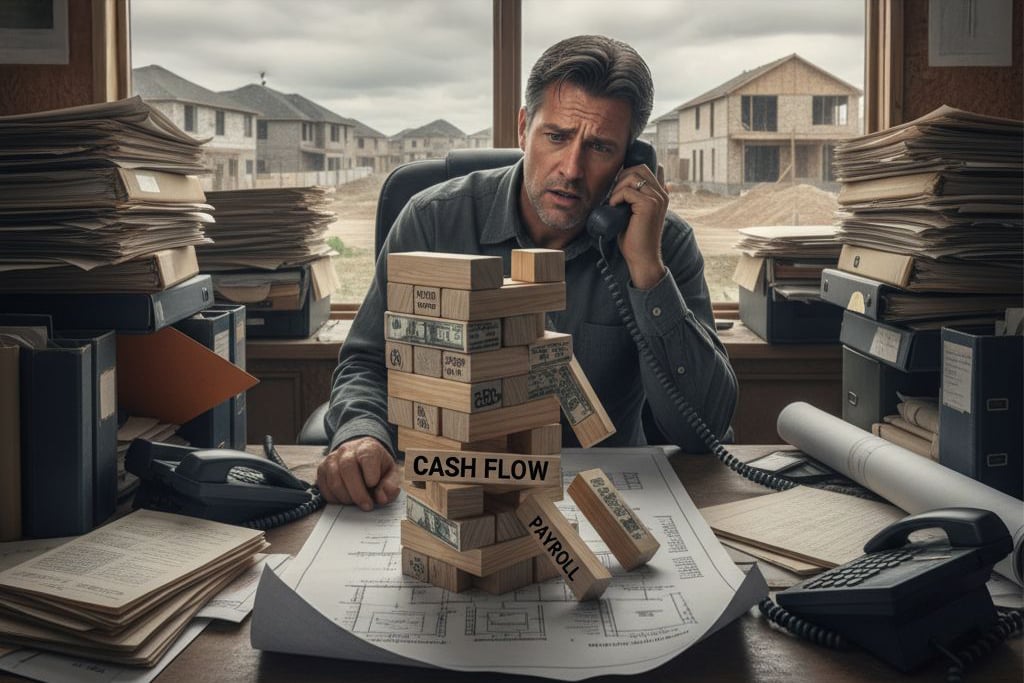
The Hidden Reason Good Builders Go Broke
Most builders don’t fail from lack of work—they fail from too much of the wrong kind.
Here’s something nobody talks about at industry conferences: The most dangerous time for a construction company isn’t when work dries up. It’s when the phone won’t stop ringing.
Sounds backwards, right?
But the data tells a different story. Nearly 40% of construction companies fail within five years of starting. Over half don’t make it to ten. And the ones that collapse aren’t usually the companies scraping for work. They’re the ones drowning in it.
The question is: why?
The Problem Isn’t Sales. It’s Structure.
Most builders start the same way. You’ve got a skill, some grit, and enough cash from savings—or maybe a loan from family—to get rolling. You do good work. Word spreads. Projects come in.
And then something shifts.
You hit a revenue number—usually somewhere between $3 million and $10 million—where everything that used to work suddenly doesn’t. The systems you ran on instinct start breaking. The crew you trusted can’t keep up. And your cash? It’s spread across three projects, tied up in retainage, waiting on draws that won’t hit for another 45 days.
You’re busier than ever. And you’re bleeding.
This is where most builders make the mistake that eventually kills them: they chase more work to fix the cash problem.
It never works. You can’t out-revenue a structural problem.
The Cash Flow Trap Nobody Warned You About
Construction is unlike almost any other business when it comes to cash. You’re financing jobs before you get paid. You’re covering payroll while waiting on architects to approve invoices. You’re sitting on 10% retainage for months—sometimes years—after the work is done.
And here’s the kicker: the bigger the job, the worse it gets.
That $2 million project you just landed? It might require $300,000 in working capital before you see your first draw. Where does that come from? For most builders, it comes from the next project. And the one after that. Until you’re juggling so many balls that one slow-paying client sends the whole thing crashing down.
The industry has a name for this: “growing broke.” And it’s more common than anyone admits.
Why Traditional Solutions Fall Short
So you go looking for help. What do you find?
Banks want two years of perfect financials and collateral you don’t have. They’re underwriting your past, not your potential.
Private equity wants majority control and a 3-5 year exit. They’re not building your company—they’re flipping it.
Venture capital? Doesn’t even look at construction. Too slow-moving. Too capital-intensive. Not “scalable” enough for their models.
You’re left with options designed for industries that don’t understand how construction actually works. Terms that don’t account for retainage. Partners who’ve never managed a draw schedule or dealt with a GC who pays 90 days late.
Is it any wonder so many good builders end up overleveraged or owned by people who don’t know the difference between a punch list and a pay app?
The Question Nobody Asks
Here’s what I’ve learned from watching this pattern play out: The builders who survive the growth phase aren’t the ones who work harder or bid lower or find the magic banker who “gets it.”
They’re the ones who ask a different question.
Instead of “How do I get more capital?” they ask: “How do I structure my capital so it actually fits how I build?”
That’s not a minor distinction. It’s the whole game.
Because capital from someone who’s never run a crew or sweated out a weather delay is just… money. It comes with terms designed for spreadsheets, not jobsites. It creates pressure to grow faster than your systems can handle. It turns owners into employees of their own companies.
Capital from someone who understands the rhythm of construction—who knows why you can’t just “bill faster” or “tighten up receivables”—is something else entirely. It’s infrastructure. It’s breathing room. It’s the difference between scaling smart and scaling broke.
What Good Capital Actually Looks Like
The right capital partner isn’t going to hand you a term sheet on the first call. They’re going to ask questions:
What does your project pipeline actually look like? Where are your cash crunches hitting—mobilization, mid-project, close-out? What would change if you didn’t have to take every job just to cover the ones you’re already running?
They’re going to understand that construction businesses don’t need growth capital the way tech startups do. You don’t need someone betting on 100x returns in five years. You need a partner who can bridge the cash gaps that come with building something real—and who won’t disappear when things get bumpy.
Because things always get bumpy.
The Bottom Line
If you’re a builder hitting that uncomfortable growth ceiling—too busy to breathe, too stretched to take on the work that could actually move you forward—know this: the problem isn’t that you need to work harder.
The problem is structural. And structural problems require structural solutions.
Not more hours. Not more bids. Not capital from people who’ve never built anything.
The right partner. The right structure. And the patience to build something that lasts.
Because good builders don’t go broke from lack of work.
They go broke from building on the wrong foundation.
—
If you’re a builder navigating growth and want to talk through what strategic capital could look like for your situation, reach out. No pitch—just a conversation about what’s actually working in the market right now.